- info@SeqMatic.com
 Mon - Fri 9AM - 7PM PST
Mon - Fri 9AM - 7PM PSTParse Biosciences
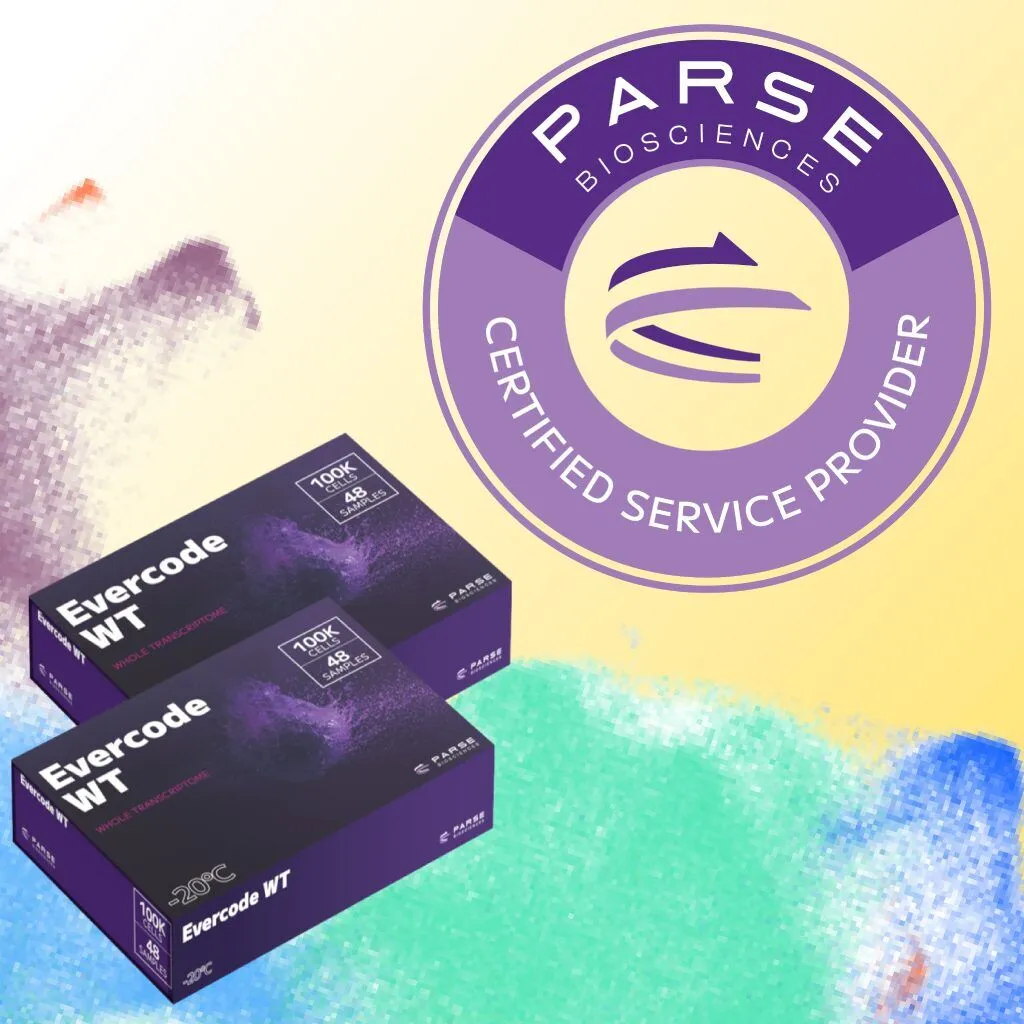
Parse Biosciences Evercode is a combinatorial barcoding platform for single cell and single nuclei RNA sequencing. Unlike droplet-based systems, Evercode does not require a microfluidics instrument to isolate individual cells. Instead, cells themselves serve as the reaction compartment.
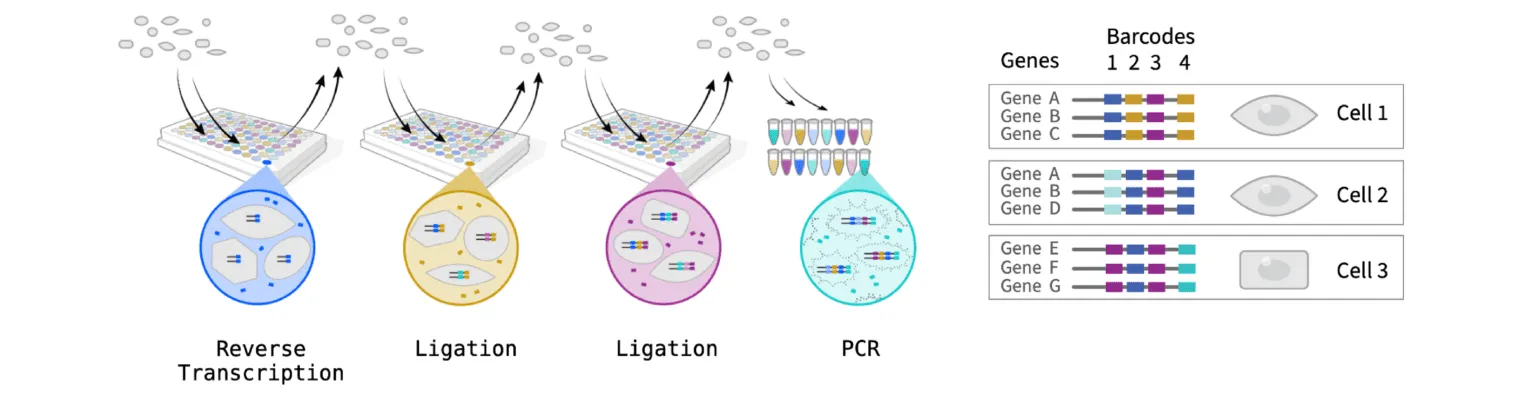
The workflow begins with fixation and permeabilization. Cells are fixed using the Parse fixation kit, which preserves RNA in place and allows samples to be stored for up to six months before processing. Fixed cells are then distributed across wells of a plate, and in each well, a unique barcode is introduced through reverse transcription. The cells are pooled, redistributed into new wells with a second set of barcodes, and the process is repeated. After four rounds of split and pool barcoding, each cell carries a unique combination of barcodes that identifies it from every other cell in the experiment.
Because the barcode combinations scale exponentially with each round, Evercode generates millions of unique cell identifiers without requiring physical isolation of individual cells. This is what enables the platform to scale from 10,000 cells to 5 million cells using the same core chemistry.
Evercode sequences across the entire transcript rather than capturing only the 3′ or 5′ end. This full length coverage enables improved isoform detection, more robust gene quantification, and greater tolerance of incomplete or imperfect genome annotations — an important advantage for non-model organisms or species with draft reference genomes.
SeqMatic offers the complete Parse Biosciences Evercode product line. Each kit is designed for a different scale of experiment. Kit specifications reflect the latest Parse Biosciences product updates. CRISPR Detect is actively offered.
| Kit | Cell Capacity | Samples per Kit | Best For |
|---|---|---|---|
| Evercode WT Mini | Up to 10,000 | 1 – 12 | Pilot studies, low cell count samples, cost effective screening |
| Evercode WT | 10,000 – 100,000 | 1 – 48 | Standard single cell experiments, mid scale studies |
| Evercode WT Mega | 100,000 – 1,000,000 | 1 – 384 | Large scale studies, atlas projects, multi-site collaborations |
| Evercode WT Penta | 1,000,000 – 5,000,000 | 1 – 384 | Population scale studies, ultra high throughput, drug discovery |
| Evercode WT FFPE (Mini, WT, Mega, Penta) | Kit dependent | Kit dependent | Formalin Fixed Paraffin Embedded tissue analysis across all scales |
| Evercode BCR (Mini, WT, Mega) | Kit dependent | Kit dependent | B cell receptor immune repertoire profiling (human and mouse) |
| Evercode TCR (Mini, WT, Mega) | Kit dependent | Kit dependent | T cell receptor immune repertoire profiling (human and mouse) |
| CRISPR Detect Add-on | Kit dependent | Kit dependent | CRISPR screen readout at single cell resolution |
Note: All Evercode whole transcriptome kits are species agnostic. BCR/TCR kits are human and mouse only.
Fixation is a key feature of the Parse Biosciences workflow. When cells are fixed at the point of collection, several challenges that affect fresh sample workflows are addressed:
Viability decay. Fresh cells lose viability during transit, dissociation, and processing. Every hour between sample collection and library preparation degrades data quality. Fixed cells are stable for up to six months, so there is no viability clock.
Batch effects from temporal separation. In time course studies, drug dosing experiments, or multi-site collaborations, samples are collected on different days, weeks, or months. With fresh sample workflows, each collection point introduces a processing batch, and batch effects confound biological signal. With Evercode, all fixed samples can be pooled and processed in a single run regardless of when they were collected, eliminating this source of technical variation.
Geographic constraints. Researchers outside the San Francisco Bay Area (or outside shipping range for fresh samples) can fix cells at their own lab and ship them to SeqMatic on dry ice with no urgency, making Parse Biosciences accessible to labs anywhere in the country.
For retrospective studies on banked tissue collections, fixation also unlocks samples that would otherwise be unusable for single cell sequencing. FFPE sections, frozen tissue banks, and archived clinical specimens can all be processed through the Evercode pipeline using the dedicated FFPE kit variants.
Fixation method. Samples can be fixed at the point of collection using the Parse Biosciences fixation kit. If SeqMatic performs the fixation, SeqMatic purchases the fixation kits. If the customer fixes the cells at their own lab, the customer purchases the kits directly from Parse Biosciences. SeqMatic can accept cells fixed with non-Parse protocols but does not recommend them, and non-Parse protocols are not supported by Parse Biosciences.
Cell count. Minimum cell input varies by kit. The WT Mini kit supports as few as 10,000 cells, making it suitable for pilot studies. The WT, WT Mega, and WT Penta kits scale upward from 100,000 to 5 million cells. SeqMatic scientists help determine the optimal kit based on your target cell count, expected cell loss during fixation, and experimental design.
Sample format. SeqMatic accepts fixed single cell suspensions, fixed nuclei, fresh tissues for in-house dissociation and fixation, and frozen tissues. Samples should be shipped on dry ice when fixed per Parse protocol.
For customers who wish not to fix samples themselves, SeqMatic accepts single cell suspensions, nuclei, fresh tissues for in-house dissociation and fixation, FFPE and frozen tissues. Fresh tissues should be stored in an appropriate tissue storage buffer and shipped at 4C. All other samples should be shipped on dry ice.
Species. Evercode whole transcriptome kits are species agnostic and work with any organism for which a reference transcriptome is available. BCR and TCR kits are currently limited to human and mouse. SeqMatic has successfully processed single cell RNA workflows for non-model organisms on the Parse platform. The species listed below are examples, not an all-inclusive list. If your species of interest is not listed, contact SeqMatic to discuss feasibility.
Examples: rat, chicken, cattle, pig, horse, dog, ground squirrel, non-human primates (NHP), soybeans, cotton, tomato, potato, wheat, grape, banana slugs, salmon, and catfish.
Parse Biosciences recommends sequencing Evercode whole transcriptome libraries at a depth sufficient to detect the target number of genes per cell. General guidance is provided below. Actual recommendations may vary depending on cell type and experimental goal: a complex sample type may require more reads, while cell culture experiments may need fewer reads.
| Library Type | Recommended Depth | Unit |
|---|---|---|
| Whole Transcriptome (WT / WT Mini / WT Mega / WT Penta) | 20,000 – 40,000 | reads per cell |
| WT FFPE (Mini / WT / Mega / Penta) | 20,000 – 40,000 | reads per cell |
| BCR / TCR | ~5,000 | reads per cell |
| CRISPR Detect | ~10,000 | reads per cell |
Source: Parse Biosciences published documentation. SeqMatic may adjust based on experimental goals.
SeqMatic sequences Parse Biosciences libraries on Illumina platforms (NovaSeq X Plus or NextSeq) and Ultima Genomics (UG100). The sequencing platform is selected based on the total number of cells, required depth, and library complexity.
SeqMatic is a Certified Service Provider for both Parse Biosciences and 10x Genomics, and offers Scale Bio kits under the 10x umbrella.
Parse Biosciences Evercode is the strongest option when:
Either Parse Biosciences Evercode or 10x Genomics Flex Apex are strong options when:
10x Genomics Chromium is the stronger choice when:
If you are evaluating multiple platforms, SeqMatic can design a pilot experiment on each and help you compare results before committing to a full scale study.

Cell or Nucleic Fixation
Fixation Options
Project Customizations
Flexibility & Convenience
Stringent Quality Controls
Your single cell submissions are assessed with Countess III FL to quantify cell concentration in suspension and cell viability before Chromium processing. Working carefully with your SeqMatic team to prepare your submission ensures superior cell recovery.
Scientific considerations for read depth
SeqMatic recommends a read depth of 10 to 20K read pairs per cell/nucleus. Higher and lower read depths are available depending on model organism requirements and/or project needs.
Preliminary Sequencing
After library preparation, SeqMatic prepared libraries are pooled to customer requirements and the final QC is checked via preliminary sequencing. For Universal 3′ or 5′, libraries are then normalized and re-pooled based on the cell/nuclei count from the preliminary sequencing .
World-class validation standard & practices
SeqMatic is equipped to ensure accurate, repeatable and reproducible results. SeqMatic’s quality program has been audited and approved as part of becoming a Clinical Laboratory Improvement Amendments (CLIA) and College of American Pathologists (CAP) certified sequencing facility. Our CLIA quality program requires the use of well-defined protocols to maintain the consistency and reproducibility of our NGS workflows.
Custom assay services
Our highly personalized sequencing services can be adapted to almost any (high and/or low throughput) sequencing workflow required by our customers so that we optimize the quality and quantity of data output.

Your S.F. Bay Area Advantage!
To maintain maximum sample viability, your samples can be transported to us
within 1 to 2 hours from any where in the SF Bay Area – Request a Quote!

SeqMatic’s Premium Services
Onsite-SeqTM brings our experts to your lab for sample fixation

SeqMatic’s Premium Services
Fetch-SeqTM courier pick-up in the S.F. Bay Area
Yes. Researchers can fix cells at their own lab using the Parse Biosciences fixation kit (purchased directly from Parse Biosciences). Fixed cells are stable for up to six months, so shipping timelines are not a constraint. Fixed samples are shipped on dry ice. SeqMatic can accept cells fixed with non-Parse protocols but does not recommend them, as non-Parse protocols are not supported by Parse Biosciences. This makes Parse Biosciences Evercode accessible to labs anywhere in the country, regardless of proximity to SeqMatic’s Fremont facility.
Evercode whole transcriptome kits are species agnostic. Any organism with an available reference transcriptome can be processed, including non-model organisms. SeqMatic has processed single cell and single nuclei samples from human, mouse, and a wide range of additional species on the Parse platform, including crops, marine life, livestock, and wildlife. The species list above is not all inclusive. If your species of interest is not listed, contact SeqMatic to discuss feasibility. BCR and TCR immune repertoire kits are currently available for human and mouse only.
For non-model organisms, Parse Evercode offers an advantage over 3′ end capture platforms: because Evercode sequences across the entire transcript, it provides greater tolerance of incomplete or poorly annotated reference genomes and enables more robust gene quantification even when annotations are imperfect. SeqMatic also builds custom reference genomes and functional annotations for species without existing references.
The Evercode WT Mini kit supports as few as 10,000 cells, making it the most flexible option for pilot studies. There is no strict lower limit on cell input; however, very low cell counts may result in reduced gene detection per cell and higher per cell sequencing costs because the same library preparation and sequencing resources are applied to fewer cells. SeqMatic scientists can help you evaluate which Parse kit is the best solution.
Yes. This is one of the primary advantages of the Evercode fixation workflow. Samples collected days, weeks, or even months apart can be fixed at the point of collection and stored until all samples are ready for processing. All fixed samples are then pooled into a single split and pool run, which means every sample goes through identical processing conditions. This eliminates batch effects that arise when samples are processed in separate runs on different days. For time course studies, multi-site collaborations, and longitudinal experiments, this is a significant advantage over fresh sample workflows where each collection point introduces a new processing batch.
Yes. Formalin fixed paraffin embedded (FFPE) tissue sections are compatible with the Parse Biosciences Evercode workflow through the dedicated FFPE kit variants (WT FFPE Mini, WT, Mega, and Penta). Because Evercode uses fixed, permeabilized cells as the reaction compartment, the chemistry is inherently compatible with samples that have already been fixed.
For FFPE processing, tissue sections are deparaffinized, rehydrated, and dissociated into single nuclei or single cells before entering the Evercode split and pool barcoding pipeline. The quality of the resulting data depends on the fixation and storage conditions of the FFPE block: recently prepared blocks with shorter fixation times tend to produce better results than blocks that have been in storage for many years or were overfixed. SeqMatic performs quality assessment on FFPE derived samples upon receipt and can advise on whether the sample quality is sufficient for single cell resolution data before committing to a full library preparation.
Note: 10x Genomics Flex Apex also supports FFPE samples through a probe based approach. The choice between Parse FFPE and Flex Apex depends on whether you need full length transcript coverage and species agnostic chemistry (Parse) or 10x ecosystem compatibility and large scale sample multiplexing (Flex Apex). SeqMatic can advise on which approach is best for your specific FFPE samples.
Yes. SeqMatic offers bioinformatics analysis at three tiers for Parse Biosciences data:
Primary — using Split-pipe. Raw sequencing reads are processed and converted into a structured gene cell expression matrix through barcode demultiplexing, read alignment, and count matrix construction. Deliverables include web summary reports, a gene–cell expression matrix, and aligned BAM files.
Secondary — downstream analysis where the resulting expression count matrix is subjected to quality control, normalization, and filtering to remove low quality cells and technical artifacts. Deliverables include a QC filtered expression matrix, a cell level QC metrics table, a normalized expression matrix, and QC reports and plots.
Tertiary — interpretation of the biological structure of the data by performing dimensionality reduction, clustering, and cell type annotation using tools such as Seurat or Scanpy. Deliverables include a processed AnnData object, cluster annotations with assigned cell types, dot plots and violin plots of marker genes, and differential gene expression (DGE) results for each cluster or cell type.
Standard turnaround for Parse Biosciences projects is 3 to 6 weeks from sample receipt to data delivery. This includes sample QC, split and pool barcoding, library preparation, sequencing, and primary data analysis. Expedited turnaround is available in as few as 2 weeks. For large scale studies using the WT Mega or WT Penta kits, turnaround may extend depending on the total number of cells and required sequencing depth.