- info@SeqMatic.com
 Mon - Fri 9AM - 7PM PST
Mon - Fri 9AM - 7PM PST10x Genomics
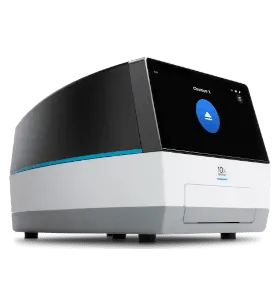
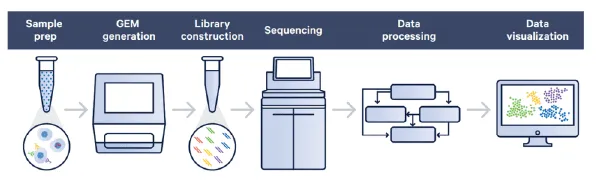
10x Genomics Chromium is a droplet-based single cell sequencing platform that partitions individual cells into nanoliter scale gel bead in emulsion (GEM) droplets. Inside each GEM, the cell is lysed and its mRNA is captured by a barcoded gel bead, tagging every transcript with a cell specific molecular identifier. After reverse transcription, the barcoded cDNA from all droplets is pooled into a single library for sequencing. Because each transcript carries its cell of origin barcode, the resulting data can be computationally deconvolved to reconstruct the transcriptome of every individual cell.
SeqMatic operates the Chromium X series instrument and is a 10x Genomics Certified Service Provider (CSP). The Chromium X supports up to 20,000 cells per channel. SeqMatic handles the full workflow from sample receipt through sequencing and data analysis, so your team does not need to own or operate a Chromium instrument.
Scientists use single cell sequencing to resolve cellular heterogeneity, rare cell types, and individual cell trajectories that are masked by the averaged expression profile of bulk RNA sequencing. Where bulk RNA seq produces a single readout representing the average of millions of cells, single cell RNA seq reveals the distinct molecular identity of each cell in the sample. The difference matters for any study where cell populations are mixed, shifting, or functionally distinct.
Single cell sequencing is the stronger approach when you need to uncover cellular heterogeneity within tissues that contain multiple cell types or states, identify rare cell populations (such as drug resistant subclones or stem cells) that represent a small fraction of the total, map how cells change over time through differentiation, disease progression, or treatment response, characterize how cell types interact with each other and their local environment, or detect mutations at the single cell level to determine zygosity and mutational co-occurrence directly rather than by inference.
Bulk RNA seq remains appropriate for studies comparing overall expression differences between known conditions (such as control vs treatment) when individual cell variation is not the primary focus, or for studies where cost, sample availability, or throughput constraints make single cell approaches impractical. Many projects benefit from both: bulk RNA seq for broad comparisons, followed by single cell sequencing to dissect the cell type specific changes driving the observed differences.
SeqMatic supports the complete range of 10x Genomics single cell library types. Each library type captures different molecular information from the same cell, and multiple library types can be combined in a single experiment for multi-omic profiling.
Universal 3′ Gene Expression (Standard Transcriptome Profiling). The 3′ assay captures polyadenylated transcripts from the 3′ end and is the most widely used configuration for transcriptome profiling, cell type identification, and differential expression analysis. Applications include cell type classification, rare cell detection, disease vs healthy comparisons, time course expression analysis, and drug response profiling.
Universal 5′ Gene Expression. The 5′ assay captures from the 5′ end and is required for paired immune receptor (V(D)J) sequencing workflows. Choose 5′ when your study involves immune profiling with clonotype analysis alongside gene expression.
Immune Profiling with paired V(D)J (BCR and TCR). Immune profiling pairs 5′ gene expression with BCR and/or TCR assembly from the same cell, enabling simultaneous characterization of immune cell transcriptomic state and clonotype identity. Applications include clonal expansion analysis, vaccine response monitoring, tumor infiltrating lymphocyte characterization, autoimmune disease profiling, and antibody discovery.
single cell immune profiling →
Feature Barcoding and CITE seq. Feature Barcoding enables measurement of surface proteins alongside gene expression using antibody derived tags (ADTs). CITE seq is the most common implementation, where oligo conjugated antibodies bind cell surface markers and are captured during GEM generation. Researchers can supply their own panels or work with SeqMatic to select from validated vendors. Key antibody panel vendors include BioLegend (TotalSeq A, B, and C for 3′ and 5′ workflows), Abcam (Lightning-Link conjugation kits validated for 5′ immune profiling), Proteintech Genomics (MultiPro panels designed for Chromium Flex), and Bio-Rad (conjugated antibodies for multiplexed cell surface analysis). Feature Barcoding can be combined with Cell Hashing for sample multiplexing.
Cell Hashing. Cell Hashing uses oligo tagged antibodies to label cells from different samples before pooling them into a single Chromium channel. After sequencing, hashtag barcodes demultiplex cells back to their sample of origin. Applications include sample multiplexing to reduce cost, doublet detection, and experiments comparing multiple conditions or donors within the same run.
Flex Apex / Fixed RNA Profiling. Flex Apex is a probe based gene expression assay that works on fixed cells, FFPE sections, and low quality RNA samples. It does not require high viability fresh cells. Cells are fixed with paraformaldehyde, hybridized with probe pairs targeting the transcriptome, and loaded onto the Chromium X. The latest GEM-X Flex Apex system supports up to 1 million cells per GEM well, up to 384 samples in 96 well plate format, and a fixation input of up to 10 million cells per sample. Applications include FFPE tissue analysis, archived clinical specimens, time course studies, and large scale studies requiring sample multiplexing.
Single cell Epi Chromatin (ATAC). Single Cell ATAC seq measures chromatin accessibility at single cell resolution by identifying open regions of DNA where transcription factors can bind. Uses nuclei rather than whole cells, compatible with frozen tissues. Applications include gene regulatory network inference and enhancer identification.
Single cell Epi Multiome (ATAC + Gene Expression). Multiome combines ATAC and gene expression from the same nucleus in a single workflow, linking epigenomic state to transcriptomic output. Requires isolated nuclei; primary analysis uses Cell Ranger ARC. Applications include developmental trajectory analysis at the epigenomic level and linking regulatory elements to the genes they control.
10x Genomics acquired Scale Biosciences in August 2025, bringing a combinatorial indexing approach into the 10x ecosystem. Scale Bio kits use split and pool barcoding and are now part of the 10x Genomics product family. SeqMatic offers the Scale Bio product line:
The Scale Bio acquisition gives SeqMatic customers access to instrument-free high throughput single cell RNA sequencing and single cell methylation profiling within the 10x ecosystem. For researchers studying epigenetic regulation at single cell resolution, the Methylation kit fills a gap that no other platform currently addresses.
Sample quality is the single largest determinant of data quality in single cell sequencing. The requirements below apply to standard 10x Genomics workflows at SeqMatic.
Cell viability. A minimum viability of 80% is recommended for standard GEx and immune profiling workflows. Higher viability (above 90%) produces cleaner data with lower ambient RNA contamination. If viability falls below 80%, SeqMatic discusses options with the customer: proceed with the understanding that recovery rates and data quality may be reduced, decline to proceed, or switch to the single nuclei RNA seq workflow, which eliminates viability constraints by profiling isolated nuclei instead of intact cells. The decision depends on the sample type, experimental goals, and whether the customer is willing to accept the tradeoffs.
Cell count and concentration. For 10x Genomics Chromium, a typical target is 500 to 20,000 cells per channel with the standard kit. SeqMatic recommends submitting a minimum of 2x and preferably greater than 3x the target cell count to account for losses during processing. For tissues, submit at least 50 mg of fresh tissue per sample for optimal cell recovery, or 50 mg of cryopreserved tissue for nuclei isolation. For cryopreserved cell suspensions, submit a minimum of 1 million cells per sample.
Accepted sample formats. SeqMatic accepts single cell suspensions (fresh or cryopreserved), isolated nuclei (for ATAC, Multiome, and Flex Apex), and fixed cells (for Flex Apex workflows). Intact tissues can be submitted for in-house dissociation across all tissue types and species. Cryopreserved samples should be shipped on dry ice with a validated cryopreservation protocol to maintain viability upon thawing. Choosing the proper preservation chemistry is critical to project success. SeqMatic has experience with numerous preservation reagents and can recommend the best chemistry for your specific tissue type. Recommended protocols are provided during technical discussion with the SeqMatic scientific team. For additional guidance on cell shipping, see the 10x Genomics knowledge base article on sample transport.
Species. 10x Genomics provides reference genomes for human and mouse. SeqMatic also supports non-model organisms using custom reference genomes, as well as customized human and mouse genomes for transgenic models and custom vectors. FFPE workflows on 10x Genomics are currently limited to human and mouse. Non-model species successfully processed at SeqMatic on the 10x Chromium platform include the examples below. This list is not all inclusive. If your species of interest is not listed, contact SeqMatic to discuss feasibility.
Examples: rat, chicken, cattle, pig, horse, dog, squirrel, non-human primates (NHP), soybeans, cotton, tomato, potato, wheat, grape, banana slugs, salmon, catfish, amoebas, and sea anemones.
Sequencing depth directly affects the number of genes detected per cell and the statistical power of downstream analyses. The table below shows recommended minimum sequencing depth per library type based on 10x Genomics guidelines. SeqMatic configures sequencing runs to meet or exceed these targets. Actual recommendations may vary depending on cell type and experimental goal: complex sample types may require deeper sequencing, while cell culture experiments may need fewer reads.
| Library Type | Recommended Depth | Unit |
| Universal 3′ Gene Expression | 20,000 – 50,000 | reads per cell |
| Universal 5′ Gene Expression | 20,000 – 50,000 | reads per cell |
| Flex Apex (Fixed RNA Profiling) | 10,000 – 20,000 | reads per cell |
| Immune Profiling with paired V(D)J (BCR and TCR) | ~5,000 | reads per cell |
| Feature Barcoding / CITE seq | ~5,000 | reads per cell |
| Single cell Epi Chromatin (ATAC) | 25,000 – 50,000 | read pairs per nucleus |
| Single cell Epi Multiome (ATAC + GEx) | GEx: 20,000; ATAC: 25,000 | per cell / per nucleus |
Source: 10x Genomics published documentation. SeqMatic may adjust recommendations based on experimental goals.
SeqMatic sequences 10x Genomics libraries on Illumina platforms (NovaSeq X Plus or NextSeq) and Ultima Genomics (UG100). The sequencing platform is selected based on the number of cells, required depth, and read configuration for each library type.
Cell viability degrades with every hour between sample preparation and GEM generation. For fresh sample 10x Genomics workflows, minimizing transit time is not a convenience; it directly affects the percentage of high-quality cells captured and the level of ambient RNA contamination in the final dataset.
SeqMatic is located in Fremont, California, and offers two services designed to preserve sample quality for Bay Area researchers:
Onsite-Seq — Fixation or GEM Creation Services in Your Laboratory. SeqMatic sends a team of trained scientists along with the Chromium instrument to your lab to perform GEM creation on site. This eliminates the need to ship precious samples or cryopreserve cells and tissues (which decreases cell viability). Onsite-Seq is particularly valuable for experiments where dissociation and Chromium processing must happen at the point of collection, and for labs that do not own a Chromium instrument. Onsite-Seq is priced per visit.
Fetch-Seq — Sample Pickup Service. SeqMatic’s local courier service picks up your prepared samples door to door and delivers them to the Fremont facility, typically within 1 to 1.5 hours depending on location. Fetch-Seq is priced at a flat fee.
Both services are available to researchers in the San Francisco Bay Area and cover a 100 mile radius from Fremont, CA. No other provider currently offers either service.
For researchers outside the Bay Area, SeqMatic accepts cryopreserved cells and isolated nuclei shipped on dry ice, as well as fixed cells for Flex Apex workflows. The Flex Apex assay eliminates viability constraints entirely by fixing cells at the point of collection, making it the strongest option for remote sample submission.
SeqMatic is a Certified Service Provider for both 10x Genomics and Parse Biosciences, and offers Scale Bio kits under the 10x umbrella. As a Certified Service Provider, SeqMatic is trained and audited by 10x Genomics on current chemistries, which means your project runs on validated workflows with direct manufacturer support and early access to new assays as they are released.
10x Genomics Chromium is the strongest option when:
Either Parse Biosciences Evercode or 10x Genomics Flex Apex are strong alternatives when:
If you are unsure which platform is the best fit, SeqMatic’s team can help you evaluate options during the project consultation step and, if needed, design a pilot experiment on multiple platforms before committing to a full-scale run.
Browse frequently asked questions about Single Cell Services. Find answers to common questions, such as:
Browse a broad spectrum of sequencing solutions – SeqMatic provides a tailored approach to your research needs, including sequencing platform optimization, custom workflows, tailored-multiplexing and consistent runs led by high-value Quality Controls.

20K cells (1-8 samples) using Chromium Universal 3′ or 5′ kit
Up to 1M cells (1-384 samples) using Chromium Flex Apex kit
Comprehensive Chromium X series systems Services for single cell workflow sequencing needs.
Single cell gene expression (Flex and Universal 3′ or 5′), immune profiling BCR and/or TCR, Epi Chromatin (ATAC-seq), and Epi multiome gene expression.
Expert Volume Handling
From small projects with a few samples or low input to large scale high-throughput projects
Wide Range of Sample Types
Bioinformatics
Sequencing Platforms
Sequencing on NovaSeq 6000 and NovaSeq X Plus
Stringent Quality Controls
Your single cell submissions are assessed with Countess III FL to quantify cell concentration in suspension and cell viability before Chromium processing. Working carefully with your SeqMatic team to prepare your submission ensures superior cell recovery and GEM formation.
Scientific considerations for read depth
SeqMatic recommends a read depth of 10 to 20K read pairs per cell/nucleus. Higher and lower read depths are available depending on model organism requirements and/or project needs.
Preliminary Sequencing
After library preparation, SeqMatic prepared libraries are pooled to customer requirements and the final QC is checked via preliminary sequencing. For Universal 3′ or 5′, libraries are then normalized and re-pooled based on the cell/nuclei count from the preliminary sequencing dataset.
World-class validation standard & practices
SeqMatic is equipped to ensure accurate, repeatable and reproducible results. SeqMatic’s quality program has been audited and approved as part of becoming a Clinical Laboratory Improvement Amendments (CLIA) and College of American Pathologists (CAP) certified sequencing facility. Our CLIA quality program requires the use of well-defined protocols to maintain the consistency and reproducibility of our NGS workflows.
Custom assay services
CITE-seq add-on services available for surface protein analysis. We offer a choice of single antibody to comprehensive panels from BioLegend and Proteintech.

Your S.F. Bay Area Advantage!
To maintain maximum sample viability, your samples can be transported to us
within 1 to 2 hours from any where in the SF Bay Area – Request a Quote!


SeqMatic’s Premium Services
”Onsite-SeqTM” brings our experts to your lab
“Fetch-SeqTM” courier pick-up in the S.F. Bay Area
Yes. SeqMatic accepts cryopreserved single cell suspensions for all standard 10x Genomics workflows (Universal 3′ GEx, Universal 5′ GEx, immune profiling, Feature Barcoding). Cells should be cryopreserved using a validated protocol with a controlled rate freezer or isopropanol-based container, stored in liquid nitrogen, and shipped on dry ice. Upon receipt, SeqMatic performs viability assessment after thawing. Recovery rates from cryopreserved samples are typically 60 to 90% of the pre-freeze count, depending on cell type and cryopreservation method. For best results, submit samples with a pre-freeze viability above 90%.
Choosing the proper preservation chemistry is critical to project success. SeqMatic has experience with numerous preservation reagents and can recommend the best chemistry for your specific tissue type. Recommended protocols are provided during technical discussion with the SeqMatic scientific team. For additional reference, see the 10x Genomics knowledge base article on cell shipping:
https://kb.10xgenomics.com/s/article/360002534012-How-can-I-ship-cells
SeqMatic performs viability assessment upon sample receipt. If viability falls below 80%, the team contacts you to discuss three options: proceed with the understanding that data quality may be reduced (higher ambient RNA contamination, lower per cell gene detection), decline to proceed and return the sample, or switch to the single nuclei RNA seq workflow, which eliminates viability requirements by profiling isolated nuclei instead of intact cells. The decision depends on the specific sample, experimental goals, and acceptable tradeoffs. For samples with consistently low viability, the Flex Apex (Fixed RNA Profiling) assay is another alternative that eliminates viability constraints entirely by fixing cells before processing.
The Chromium X supports loading 500 to 20,000 cells per channel with the standard single cell kit. Cell recovery rates are typically 50 to 65% of the loaded cell count, meaning a 10,000 cell loading target will yield approximately 5,000 to 6,500 recovered cells in the final dataset. The Flex Apex assay supports up to 1 million cells per GEM well and up to 384 samples in 96 well format. Scale Bio QuantumScale kits support up to 4 million cells per plate for instrument-free workflows.
SeqMatic sequences 10x Genomics libraries on Illumina NovaSeq X Plus, NextSeq, and Ultima Genomics UG100 platforms. The platform is selected based on the number of libraries, total cell count, required sequencing depth, and read configuration. NovaSeq X Plus and UG100 are used for higher throughput projects, while NextSeq is used for smaller experiments or rapid turnaround runs. All platforms produce data compatible with the Cell Ranger analysis pipeline.
Yes. SeqMatic supports Feature Barcoding for surface protein measurement alongside gene expression using antibody derived tags (ADTs). CITE seq is the most common Feature Barcoding application and enables simultaneous transcriptomic and proteomic profiling from the same cell. Researchers can supply their own oligo conjugated antibody panels or work with SeqMatic to select panels. Key vendors include BioLegend (TotalSeq A, B, and C), Abcam (validated for 5′ immune profiling with Lightning-Link conjugation), Proteintech Genomics (MultiPro panels for Chromium Flex), and Bio-Rad (conjugated antibodies for multiplexed surface analysis). Panels are ordered as needed for each project. Feature Barcoding can be combined with Cell Hashing for sample multiplexing within the same run.
SeqMatic offers bioinformatics analysis at three tiers for 10x Genomics data:
Primary — using Cell Ranger. Raw sequencing reads are processed and converted into a structured gene cell expression matrix through barcode demultiplexing, read alignment, and count matrix construction. Deliverables include web summary reports, a gene–cell expression matrix, and aligned BAM files. For Multiome data, Cell Ranger ARC is used.
Secondary — downstream analysis where the resulting expression count matrix is subjected to quality control, normalization, and filtering to remove low quality cells and technical artifacts. Deliverables include a QC filtered expression matrix, a cell level QC metrics table, a normalized expression matrix, and QC reports and plots.
Tertiary — interpretation of the biological structure of the data by performing dimensionality reduction, clustering, and cell type annotation using tools such as Seurat or Scanpy. Deliverables include a processed AnnData object, cluster annotations with assigned cell types, dot plots and violin plots of marker genes, and differential gene expression (DGE) results for each cluster or cell type.
Standard turnaround for 10x Genomics single cell projects at SeqMatic is 3 to 6 weeks from sample receipt to data delivery. This includes sample QC, library preparation, sequencing, and primary data analysis with Cell Ranger. Expedited turnaround is available in as few as 2 weeks for time sensitive projects. Actual turnaround depends on sample quality, number of libraries, sequencing depth, and bioinformatics scope.
The 3′ and 5′ designations refer to which end of the mRNA transcript is captured and sequenced. In the Universal 3′ assay, polyadenylated transcripts are captured from the 3′ (poly A tail) end. In the Universal 5′ assay, transcripts are captured from the 5′ end.
For most standard gene expression profiling experiments (cell type identification, differential expression, clustering), the Universal 3′ assay is the default choice. It is more widely used, has more published benchmarking data, and is generally sufficient for transcriptomic characterization.
The Universal 5′ assay is required when you need paired immune receptor sequencing. V(D)J libraries for BCR and TCR repertoire analysis can only be generated from 5′ gene expression captures because the variable regions of immune receptors are located at the 5′ end of the transcript. SeqMatic supports both chemistries. The general rule: if you need V(D)J or plan to add immune profiling later, start with 5′. If you do not need immune receptor sequences, 3′ is the standard recommendation.
Yes. The 10x Genomics Single Cell Epi Multiome assay captures both ATAC seq (chromatin accessibility) and gene expression from the same nucleus in a single workflow. This links epigenomic state to transcriptomic output at single cell resolution. Multiome uses isolated nuclei, so it is compatible with frozen tissues and samples where intact cells cannot be recovered. Primary analysis uses Cell Ranger ARC, and downstream integration can be done using Signac, ArchR, or Seurat.
SeqMatic handles the full Multiome workflow from nuclei isolation through sequencing and primary analysis. Because Multiome requires higher sequencing depth than standard gene expression (approximately 20,000 reads per nucleus for GEx and 25,000 read pairs per nucleus for ATAC), SeqMatic configures the sequencing run to meet both targets in a single run.